

Article Sidebar
Downloads
Main Article Content
Abstract
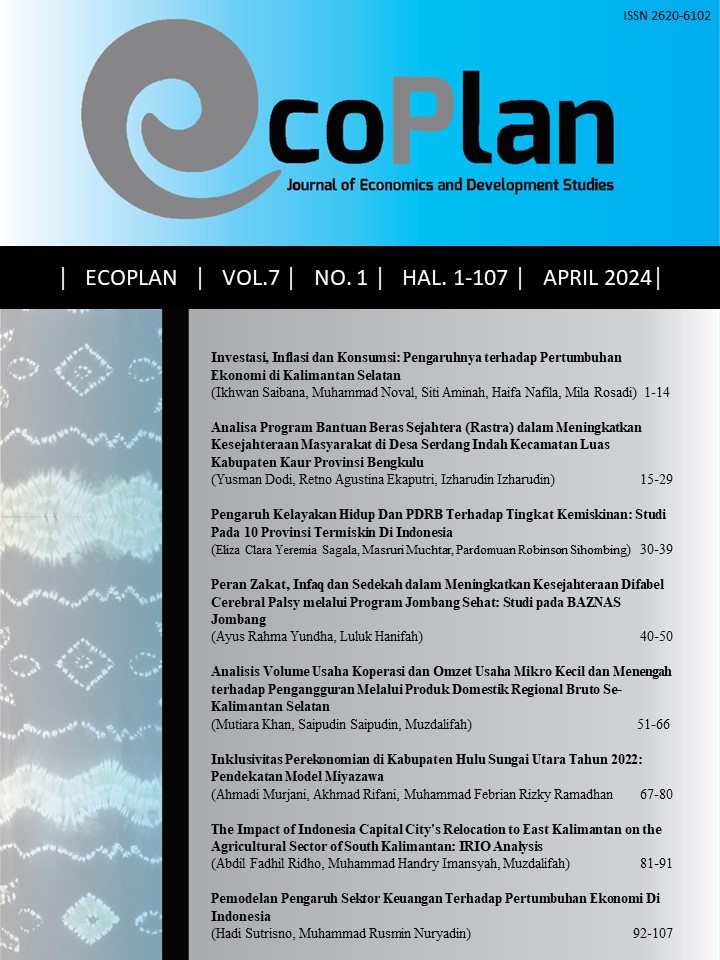
One of the goals and missions of achieving sustainable development is implementing economic development that adheres to the principle of inclusivity. Therefore, policymakers in a region must identify whether the economic development undertaken is already inclusive. Following these results, it is essential for policymakers to also conduct evaluations to determine the effectiveness of the policies made in realizing inclusive economic development. These two aspects can be addressed by applying the Miyazawa Input-Output Table. Meanwhile, over the past three years, Hulu Sungai Utara Regency has experienced a range of economic and social phenomena that necessitate further study of economic inclusivity. As a result of these conditions, the Regency has been selected as the locus for this research. The findings on the economic inclusivity in this Regency are expected to serve as a reference for policy in developing the economy of Hulu Sungai Utara. Based on the results, it is known that the economy in Hulu Sungai Utara Regency has not yet been fully inclusive. Investments in sector code E (Water Supply, Waste Management, Waste, and Recycling), sector code A (Agriculture, Forestry, and Fishery), sector code C (Manufacturing Industry), and sector code J (Information and Communication) have the potential to increase the welfare of low-income communities, which would then yield an inclusive economic development in the area.
Keywords
Article Details
References
- Adyaharjanti, A., & Hartono, D. (2020). Dampak Pengeluaran Wisatawan Mancanegara terhadap Perekonomian Indonesia. Jurnal Ekonomi Kuantitatif Terapan, 33. https://doi.org/10.24843/JEKT.2020.v13.i01.p02
- Afriliana, S. N., & Wahyudi, S. T. (2022). Analisis Pertumbuhan Ekonomi Inklusif: Studi Komparasi antar Provinsi di Indonesia. Journal of Development Economic and Social Studies, 1(1).
- Afriyana, L., Salmah, E., Sriningsih, S., & Harsono, I. (2023). Analisis Dampak Pembangunan Infrastruktur Terhadap Pertumbuhan Ekonomi Inklusif Pada Kabupaten/Kota di Provinsi Nusa Tenggara Barat Tahun 2016-2021. Elastisitas-Jurnal Ekonomi Pembangunan, 5(1), 1–12.
- Agénor, P. (2017). Caught in The Middle? The Economics of Middle‐Income Traps. Journal of Economic Surveys, 31(3), 771–791. https://doi.org/10.1111/joes.12175
- Alberti, T. M., de Souza, K., & Porsse, A. (2023). Poverty and The Functional Distribution of Income In The Input–Output Framework: In Pursuit of Strategies for Inclusive Growth. Economic Systems Research, 35(4), 614–633. https://doi.org/10.1080/09535314.2022.2067029
- Alekhina, V., & Ganelli, G. (2023). Determinants of inclusive growth in ASEAN. Journal of the Asia Pacific Economy, 28(3), 1196–1228.
- Badan Pusat Statistik. (2021). Tabel Input - Output Indonesia 2016. https://www.bps.go.id/id/publication/2021/03/31/081f6b0af2c15c524d72b660/tabel-input---output-indonesia-2016.html
- Badan Pusat Statistik. (2023). Berita Resmi Statistik Tingkat Ketimpangan Pengeluaran Penduduk Indonesia Maret 2023. https://www.bps.go.id/pressrelease/2023/07/17/2035/gini-ratio-maret-2023-tercatat-sebesar-0-388-.html
- BPS Kabupaten Hulu Sungai Utara. (2023a). Distribusi PDRB Harga Berlaku, 2010-2022. https://hulusungaiutarakab.bps.go.id/indicator/52/201/1/distribusi-pdrb-harga-berlaku.html
- BPS Kabupaten Hulu Sungai Utara. (2023b). Indeks Pembangunan Manusia Kabupaten Hulu Sungai Utara 2022 (BPS Kabupaten Hulu Sungai Utara, Ed.). BPS Kabupaten Hulu Sungai Utara.
- BPS Kabupaten Hulu Sungai Utara. (2023c). Produk Domestik Regional Bruto Kabupaten Hulu Sungai Utara menurut Lapangan Usaha 2018 - 2022 (BPS Kabupaten Hulu Sungai Utara, Ed.). BPS Kabupaten Hulu Sungai Utara.
- BPS Provinsi Kalimantan Selatan. (2023a). [Metode Baru] Indeks Pembangunan Manusia menurut Kabupaten/Kota (Umur Harapan Hidup Hasil Long Form SP2020), 2021-2023. https://kalsel.bps.go.id/indicator/26/356/1/-metode-baru-indeks-pembangunan-manusia-menurut-kabupaten-kota-umur-harapan-hidup-hasil-long-form-sp2020-.html
- BPS Provinsi Kalimantan Selatan. (2023b). Produk Domestik Regional Bruto Provinsi Kalimantan Selatan Menurut Lapangan Usaha 2018 - 2022 (BPS Provinsi Kalimantan Selatan, Ed.). BPS Provinsi Kalimantan Selatan.
- Daryanto, A., & Hafizrianda, Y. (2010). Analisis Input-Output & Social Accounting Matrix. IPB (Bogor Agricultural University).
- Dimas, P. A., & Neli, A. (2022). Inclusive Growth Analysis in Central Sulawesi, The Eastern Province of Indonesia 2015-2019. Asian Journal of Business Environment, 12(2), 1–12. https://doi.org/10.13106/AJBE.2022.VOL12.NO2.1
- Doumbia, D. (2019). The Quest for Pro-Poor and Inclusive Growth: The Role of Governance. Applied Economics, 51(16), 1762–1783. https://doi.org/10.1080/00036846.2018.1529392
- Dyah Hapsari, S. A., Hutagaol, M. P., & Asmara, A. (2018). Pertumbuhan Inklusif: Fenomena Pertumbuhan Inklusif di Kawasan Indonesia Bagian Barat dan Bagian Timur. Jurnal Ekonomi Dan Kebijakan Pembangunan, 2(2), 85–112. https://doi.org/10.29244/jekp.2.2.2013.85-112
- Edinak, E. A., Sayapova, A. R., & Shirov, A. A. (2022). Endogenization of Household Consumption in The Expanded Input–Output Model. Studies on Russian Economic Development, 33(1), 1–10. https://doi.org/10.1134/S1075700722010063
- Hardiwan, D., Amir, A., Junaidi, J., & Delis, A. (2019). The Linkages and Impact of Plantation-Based Sectors on Economy and Poverty in Jambi Province, Indonesia: Miyazawa’s Input-Output Model. Agricultural and Resource Economics: International Scientific E-Journal, 5(3), 5–19. https://doi.org/10.51599/are.2019.05.03.01
- Hidayat, I., Mulatsih, S., & Rindayati, W. (2020). The determinants of inclusive economic growth in Yogyakarta. Jurnal Economia, 16(2), 200–210.
- Imansyah, M. H., Hartono, D., & Putranti, T. (2023). The Impacts of Digital Economy on Green Economy: The Indonesian Miyazawa Model. Polish Journal of Environmental Studies, 32(2).
- Iskandar, A. (2016). Pertumbuhan Inklusif di Provinsi Sulawesi Selatan dan Faktor-faktor yang Memengaruhinya. Jurnal BPPK, 9.
- Miller, R. E., & Blair, P. D. (2009). Input-Output Analysis: Foundations and Extensions. Cambridge university press.
- Miyazawa, K. (1968). Input-Output Analysis and Interrelational Income Multiplier as a Matrix. Hitotsubashi Journal of Economics, 8(2), 39–58. https://EconPapers.repec.org/RePEc:hit:hitjec:v:8:y:1968:i:2:p:39-58
- Murjani, A. (2019). Short-run and Long-run Impact of Inflation, Unemployment, and Economic Growth Towards Poverty in Indonesia: ARDL Approach. Jurnal Dinamika Ekonomi Pembangunan, 2(1), 15–29. https://doi.org/10.14710/jdep.2.1.15-29
- Nehemia, S. D., & Prasetyia, F. (2023). Analisis Pengaruh Penanaman Modal Dalam Negeri dan Penanaman Modal Asing terhadap Pertumbuhan Ekonomi Inklusif Di Indonesia. Journal of Development Economic and Social Studies, 2(1), 26–37.
- Purwanti, S., & Rahmawati, F. (2021). Pengaruh Pengeluaran Pemerintah dan Tingkat Pengangguran Terbuka (TPT) terhadap Pertumbuhan Ekonomi Inklusif Indonesia. Ecoplan, 4(1), 32–44. https://doi.org/10.20527/ecoplan.v4i1.231
- Saari, M. Y., Dietzenbacher, E., & Los, B. (2014). Income Distribution across Ethnic Groups in Malaysia: Results from a New Social Accounting Matrix. Asian Economic Journal, 28(3), 259–278.
- Sri Hartati, Y. (2021). Analisis Pertumbuhan Ekonomi Inklusif di Indonesia. Jurnal Ekonomi Dan Bisnis, 12(1), 79–92. https://doi.org/10.55049/jeb.v12i1.74
- Sternfels, B. (2021). The Case for Inclusive Growth. https://www.mckinsey.com/capabilities/risk-and-resilience/our-insights/resilience-for-sustainable-inclusive-growth
- Varsha Pramod, P., & Ramachandran, R. (2023). Youth employment for inclusive growth: a review and research agenda in global perspective with special reference to India. Journal of Global Entrepreneurship Research, 13(1), 9. https://doi.org/10.1007/s40497-023-00354-4
References
Adyaharjanti, A., & Hartono, D. (2020). Dampak Pengeluaran Wisatawan Mancanegara terhadap Perekonomian Indonesia. Jurnal Ekonomi Kuantitatif Terapan, 33. https://doi.org/10.24843/JEKT.2020.v13.i01.p02
Afriliana, S. N., & Wahyudi, S. T. (2022). Analisis Pertumbuhan Ekonomi Inklusif: Studi Komparasi antar Provinsi di Indonesia. Journal of Development Economic and Social Studies, 1(1).
Afriyana, L., Salmah, E., Sriningsih, S., & Harsono, I. (2023). Analisis Dampak Pembangunan Infrastruktur Terhadap Pertumbuhan Ekonomi Inklusif Pada Kabupaten/Kota di Provinsi Nusa Tenggara Barat Tahun 2016-2021. Elastisitas-Jurnal Ekonomi Pembangunan, 5(1), 1–12.
Agénor, P. (2017). Caught in The Middle? The Economics of Middle‐Income Traps. Journal of Economic Surveys, 31(3), 771–791. https://doi.org/10.1111/joes.12175
Alberti, T. M., de Souza, K., & Porsse, A. (2023). Poverty and The Functional Distribution of Income In The Input–Output Framework: In Pursuit of Strategies for Inclusive Growth. Economic Systems Research, 35(4), 614–633. https://doi.org/10.1080/09535314.2022.2067029
Alekhina, V., & Ganelli, G. (2023). Determinants of inclusive growth in ASEAN. Journal of the Asia Pacific Economy, 28(3), 1196–1228.
Badan Pusat Statistik. (2021). Tabel Input - Output Indonesia 2016. https://www.bps.go.id/id/publication/2021/03/31/081f6b0af2c15c524d72b660/tabel-input---output-indonesia-2016.html
Badan Pusat Statistik. (2023). Berita Resmi Statistik Tingkat Ketimpangan Pengeluaran Penduduk Indonesia Maret 2023. https://www.bps.go.id/pressrelease/2023/07/17/2035/gini-ratio-maret-2023-tercatat-sebesar-0-388-.html
BPS Kabupaten Hulu Sungai Utara. (2023a). Distribusi PDRB Harga Berlaku, 2010-2022. https://hulusungaiutarakab.bps.go.id/indicator/52/201/1/distribusi-pdrb-harga-berlaku.html
BPS Kabupaten Hulu Sungai Utara. (2023b). Indeks Pembangunan Manusia Kabupaten Hulu Sungai Utara 2022 (BPS Kabupaten Hulu Sungai Utara, Ed.). BPS Kabupaten Hulu Sungai Utara.
BPS Kabupaten Hulu Sungai Utara. (2023c). Produk Domestik Regional Bruto Kabupaten Hulu Sungai Utara menurut Lapangan Usaha 2018 - 2022 (BPS Kabupaten Hulu Sungai Utara, Ed.). BPS Kabupaten Hulu Sungai Utara.
BPS Provinsi Kalimantan Selatan. (2023a). [Metode Baru] Indeks Pembangunan Manusia menurut Kabupaten/Kota (Umur Harapan Hidup Hasil Long Form SP2020), 2021-2023. https://kalsel.bps.go.id/indicator/26/356/1/-metode-baru-indeks-pembangunan-manusia-menurut-kabupaten-kota-umur-harapan-hidup-hasil-long-form-sp2020-.html
BPS Provinsi Kalimantan Selatan. (2023b). Produk Domestik Regional Bruto Provinsi Kalimantan Selatan Menurut Lapangan Usaha 2018 - 2022 (BPS Provinsi Kalimantan Selatan, Ed.). BPS Provinsi Kalimantan Selatan.
Daryanto, A., & Hafizrianda, Y. (2010). Analisis Input-Output & Social Accounting Matrix. IPB (Bogor Agricultural University).
Dimas, P. A., & Neli, A. (2022). Inclusive Growth Analysis in Central Sulawesi, The Eastern Province of Indonesia 2015-2019. Asian Journal of Business Environment, 12(2), 1–12. https://doi.org/10.13106/AJBE.2022.VOL12.NO2.1
Doumbia, D. (2019). The Quest for Pro-Poor and Inclusive Growth: The Role of Governance. Applied Economics, 51(16), 1762–1783. https://doi.org/10.1080/00036846.2018.1529392
Dyah Hapsari, S. A., Hutagaol, M. P., & Asmara, A. (2018). Pertumbuhan Inklusif: Fenomena Pertumbuhan Inklusif di Kawasan Indonesia Bagian Barat dan Bagian Timur. Jurnal Ekonomi Dan Kebijakan Pembangunan, 2(2), 85–112. https://doi.org/10.29244/jekp.2.2.2013.85-112
Edinak, E. A., Sayapova, A. R., & Shirov, A. A. (2022). Endogenization of Household Consumption in The Expanded Input–Output Model. Studies on Russian Economic Development, 33(1), 1–10. https://doi.org/10.1134/S1075700722010063
Hardiwan, D., Amir, A., Junaidi, J., & Delis, A. (2019). The Linkages and Impact of Plantation-Based Sectors on Economy and Poverty in Jambi Province, Indonesia: Miyazawa’s Input-Output Model. Agricultural and Resource Economics: International Scientific E-Journal, 5(3), 5–19. https://doi.org/10.51599/are.2019.05.03.01
Hidayat, I., Mulatsih, S., & Rindayati, W. (2020). The determinants of inclusive economic growth in Yogyakarta. Jurnal Economia, 16(2), 200–210.
Imansyah, M. H., Hartono, D., & Putranti, T. (2023). The Impacts of Digital Economy on Green Economy: The Indonesian Miyazawa Model. Polish Journal of Environmental Studies, 32(2).
Iskandar, A. (2016). Pertumbuhan Inklusif di Provinsi Sulawesi Selatan dan Faktor-faktor yang Memengaruhinya. Jurnal BPPK, 9.
Miller, R. E., & Blair, P. D. (2009). Input-Output Analysis: Foundations and Extensions. Cambridge university press.
Miyazawa, K. (1968). Input-Output Analysis and Interrelational Income Multiplier as a Matrix. Hitotsubashi Journal of Economics, 8(2), 39–58. https://EconPapers.repec.org/RePEc:hit:hitjec:v:8:y:1968:i:2:p:39-58
Murjani, A. (2019). Short-run and Long-run Impact of Inflation, Unemployment, and Economic Growth Towards Poverty in Indonesia: ARDL Approach. Jurnal Dinamika Ekonomi Pembangunan, 2(1), 15–29. https://doi.org/10.14710/jdep.2.1.15-29
Nehemia, S. D., & Prasetyia, F. (2023). Analisis Pengaruh Penanaman Modal Dalam Negeri dan Penanaman Modal Asing terhadap Pertumbuhan Ekonomi Inklusif Di Indonesia. Journal of Development Economic and Social Studies, 2(1), 26–37.
Purwanti, S., & Rahmawati, F. (2021). Pengaruh Pengeluaran Pemerintah dan Tingkat Pengangguran Terbuka (TPT) terhadap Pertumbuhan Ekonomi Inklusif Indonesia. Ecoplan, 4(1), 32–44. https://doi.org/10.20527/ecoplan.v4i1.231
Saari, M. Y., Dietzenbacher, E., & Los, B. (2014). Income Distribution across Ethnic Groups in Malaysia: Results from a New Social Accounting Matrix. Asian Economic Journal, 28(3), 259–278.
Sri Hartati, Y. (2021). Analisis Pertumbuhan Ekonomi Inklusif di Indonesia. Jurnal Ekonomi Dan Bisnis, 12(1), 79–92. https://doi.org/10.55049/jeb.v12i1.74
Sternfels, B. (2021). The Case for Inclusive Growth. https://www.mckinsey.com/capabilities/risk-and-resilience/our-insights/resilience-for-sustainable-inclusive-growth
Varsha Pramod, P., & Ramachandran, R. (2023). Youth employment for inclusive growth: a review and research agenda in global perspective with special reference to India. Journal of Global Entrepreneurship Research, 13(1), 9. https://doi.org/10.1007/s40497-023-00354-4